In this second installment of our two-part series on the construction industry, Rapid7 is looking at the specific threat ransomware poses, why the industry is particularly vulnerable, and ways in which threat actors exploit its weaknesses to great effect. You can catch up on the first part here: in its original form.
⠀
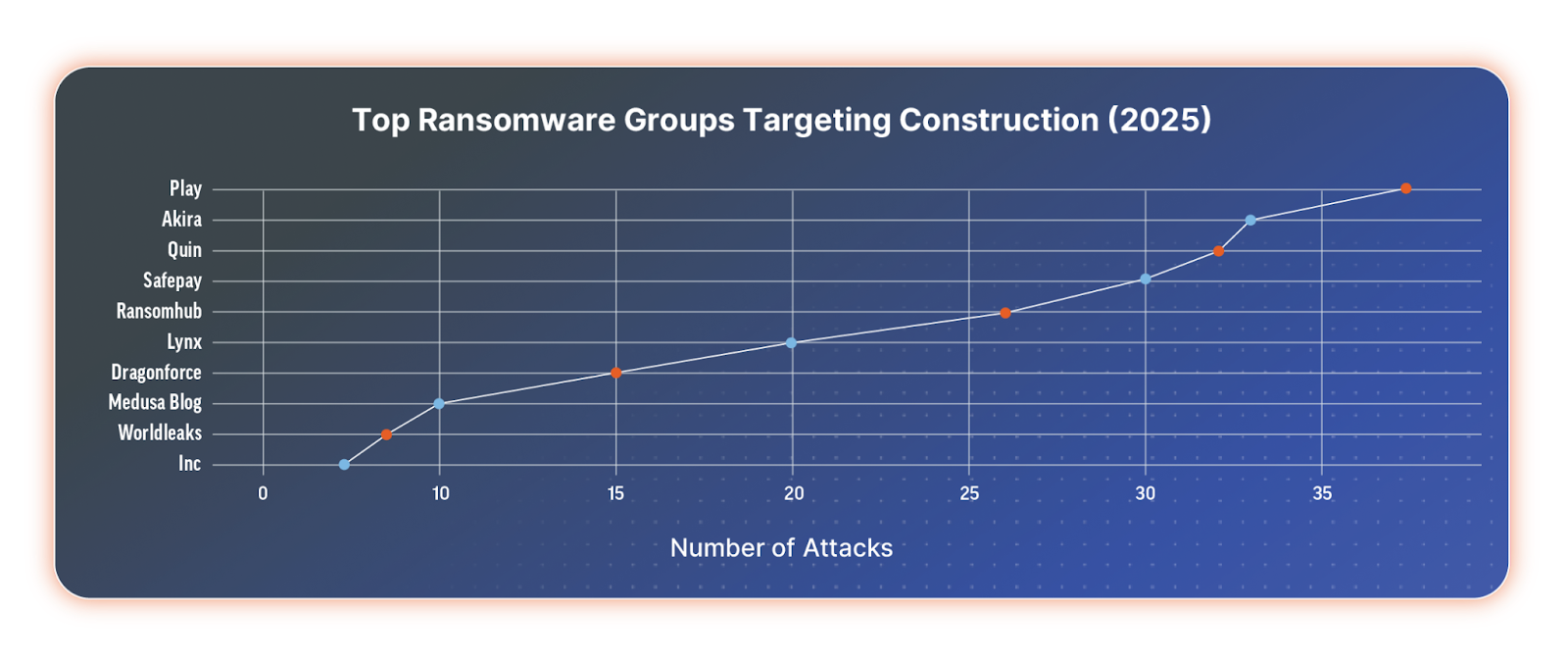
Top ransomware groups targeting the construction industry in 2025
⠀
The reasons why ransomware groups have zeroed in on this sector are diverse and include the following:
High-value, time-sensitive projects
Construction projects are high-stakes endeavors, often involving multi-million (or even billion) dollar budgets and strict delivery deadlines. Even a brief disruption, whether caused by ransomware, data breaches, or system outages, can lead to costly project delays and penalties. Attackers know this, and they exploit the sector’s reliance on tight timelines to extort higher ransoms, banking on the urgency to restore operations.
Complex, interconnected supply chains
Few industries are as dependent on an intricate web of subcontractors, vendors, and service providers. Each connection in this sprawling supply chain presents a potential vulnerability. A compromised partner can serve as a gateway for attackers, enabling threats like supply chain attacks and lateral movement across multiple organizations. Securing every link is a significant challenge, especially when third-party cybersecurity practices vary widely.
Low cybersecurity maturity
While sectors like finance and healthcare have long invested in cybersecurity, many construction firms are only beginning their journey. Legacy systems, limited IT budgets, and a traditional focus on physical rather than digital risks have left gaps in defenses. As a result, attackers often find weaker security controls, outdated software, and unpatched systems, making this sector a prime target.
Accelerated digitalization and IoT adoption
Adopting cloud platforms, Building Information Modeling (BIM), IoT sensors, and smart machinery is revolutionizing project management and delivery. However, each new digital innovation adds to the attack surface. IoT devices, in particular, often lack robust security controls, providing attackers with novel entry points that are difficult to monitor and defend.
Exposure of sensitive intellectual property
Construction firms handle more than just blueprints. Proprietary architectural designs, bid documents, financial plans, and sensitive client data are all highly valuable and highly sought after by cybercriminals. The theft or exposure of this information can have devastating consequences, from reputational damage and loss of competitive advantage to implications for critical infrastructure and national security.
Commonly exploited vulnerabilities by the above-mentioned ransomware groups include:
- The Ivanti Connect Secure and Policy Secure command injection flaw enables authenticated administrators to execute arbitrary commands on the appliances by sending specially crafted requests.
- The Fortinet FortiOS and FortiProxy authentication bypass flaw enables threat actors to remotely gain super-admin privileges by making malicious requests to the Node.js websocket module. Attackers were observed leveraging the flaw to create randomly generated admin or local users and add them to existing SSL VPN user groups or newly created ones. In addition, they add or modify firewall policies and other settings and log into the SSL VPN using these rogue accounts to allow network tunneling.
- The SonicWall SonicOS and SSLVPN improper access control flaw. It enables unauthorized threat actors to access resources and, under certain conditions, cause firewall crashes.
What to do next
In 2025, the construction industry faces unprecedented digital opportunities and rising cyber risk. IoT, BIM, and cloud platforms have boosted efficiency but expanded attack surfaces, making firms vulnerable to ransomware, supply chain breaches, and IP theft. These risks, driven by fragmented supply chains, legacy systems, human error, and insecure devices, are systemic, not isolated. Cybersecurity must now be treated as a core pillar of project management, equal to safety, cost, and schedule, requiring board-level commitment and industry-wide collaboration.
To build resilience, firms should modernize legacy systems, secure supply chains, protect connected devices, and train all staff in cyber defense. Proactive measures like risk assessments, secure-by-design technologies, unified frameworks, and incident response playbooks must replace piecemeal defenses. By embedding security into daily operations and culture, the industry can turn cyber resilience into a competitive advantage, ensuring that innovation and protection move together to secure construction’s future.

SOCIAL SHARE CARD GENERATOR