This is the technical companion to our update on Distilled, the passive signals that anti-abuse systems depended on to identify and distinguish visitors. Meanwhile advances in generative AI have rendered CAPTCHAs ineffective: bots now solve them . That hurts users, who should be free to choose the user agent they use to access the web; it hurts new browsers and agents, which struggle to interoperate; and it hurts sites, which lose legitimate visitors.
The consequence is that the web gets worse for everyone. Users get more friction or less privacy or both. Website operators see more volumetric abuse and the friction they add drives away users who would otherwise want to consume their content or services. New user agents struggle to access the same content as conventional browsers.
The Costs of Convenient Solutions
Some large ecosystem players have put forward solutions that leverage their control of the dominant operating systems and their deep integration with consumer hardware. These rely on device attestation: identifiers and privileged code baked into devices at the hardware level, which let manufacturers prove what software is running on a user’s device. Exposing this functionality to the web means attesting to sites that the user is running approved software with trusted hardware and therefore isn’t a bot. There have been two substantive proposals.
Google’s Web Environment Integrity, across their ecosystem in 2022, have more subtle issues. Built on the Privacy Pass protocol standardized at the IETF, they get a lot right: a user receives a renewed, limited batch of one-time tokens that can be presented to websites without linking their visits together. This provides privacy for users and has shown rate limits to be an effective tool for sites – both points we’ll return to later in this post.
However, Private Access Tokens rely on device attestation, requiring that the hardware manufacturer be in overall control of the user’s device. Presenting a PAT tells a website you are locked into Apple’s rules for what counts as acceptable software. Due to PAT’s technical design to reduce the friction of Cloudflare CAPTCHAs for Tor users, introduced the core primitive: a token that is unlinkable between issuance and redemption. You prove something to an issuer (e.g. by solving a CAPTCHA), receive some tokens, and later present a token to a website. The website can verify the token is legitimate, but can’t link it to the user it was issued to.
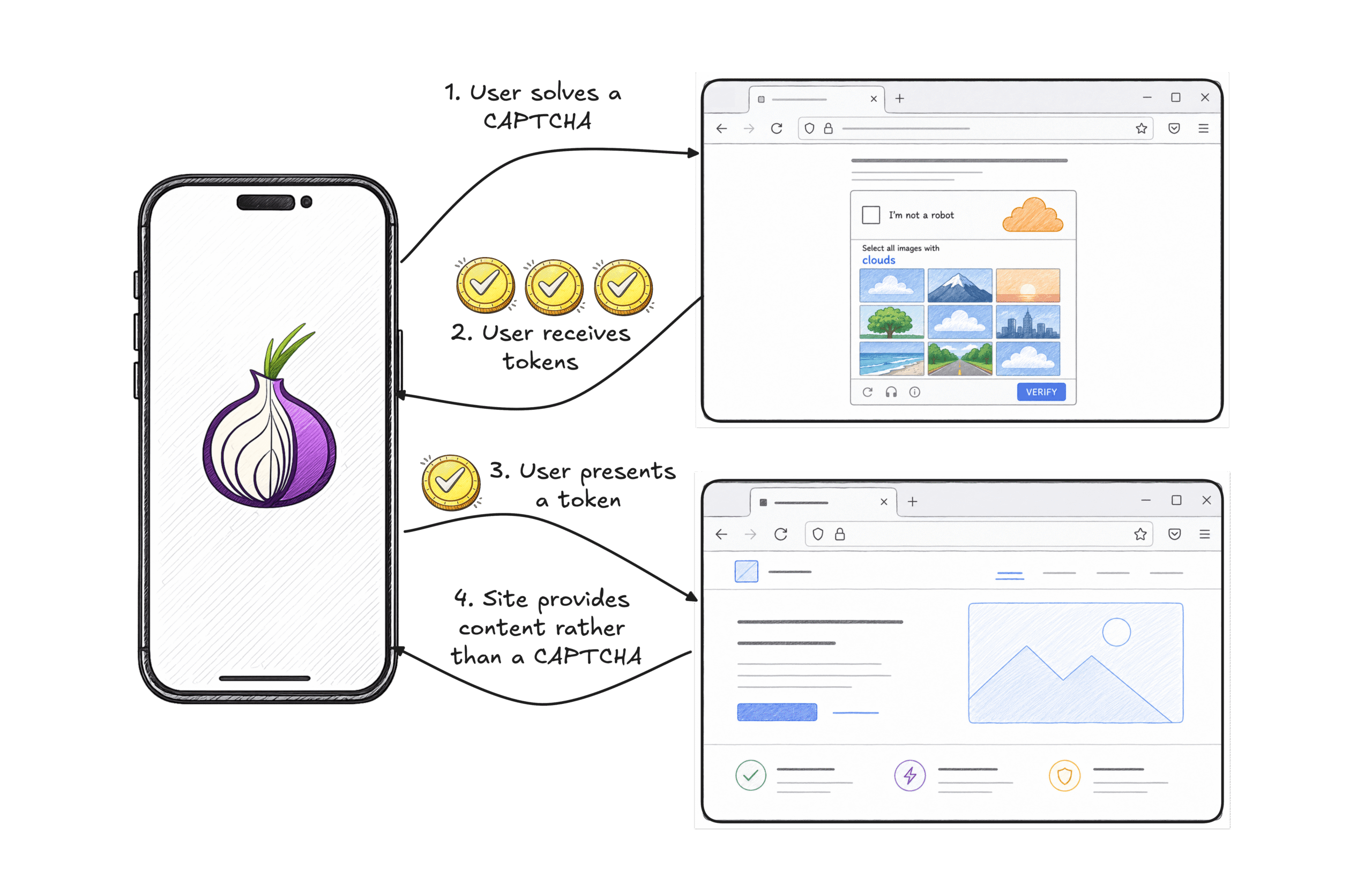
Figure 1: In Privacy Pass, a CAPTCHA provider can issue tokens to a client which can then be used to bypass challenges for future site visits. Even if the CAPTCHA provider and sites collude, they can’t use the tokens to identify the user or their browsing history.
Privacy Pass has gone on to be successfully deployed in systems where the issuer and verifier have a prior trust relationship: Apple uses it to authenticate users of , and Kagi uses it to provide . Firstly, even though tokens are unlinkable, knowing a user has access to a specific issuer is a privacy leak on its own, because you can infer that the user meets the relevant issuance criteria. If one site can learn that you have a token from another site, that reveals that you have been to that site, which can be a major privacy problem. This compounds if sites can learn the set of issuers you have visited, since it becomes a fingerprint which can be used to identify you.
tailored to the underlying cryptography can improve this considerably.
Another challenge is how sites using rate limits decide who to trust to issue tokens. If an issuer misbehaves then the site’s rate limits become ineffective, enabling volumetric abuse. However, if we need to prevent the site from learning which issuers a user has access to, the site is only going to know that one of its trusted issuers was used, not which one. This makes mistakes or misbehaviour by an issuer difficult to detect, and makes it hard for sites to evaluate new issuers. Solving this challenge is essential for openness. Without adequate information, sites are likely to lean towards conservative issuer selection. That could lead to less choice between Anchors, which in turn could lead to a new form of gatekeeper being created.
To solve this, sites at least need a way to calculate an aggregate score for each issuer they use. This should roughly correspond to how much of the traffic it considers abusive to have come from users using that particular issuer. Mozilla has long invested in systems like offer a useful building block to solve this problem. Conventional Privacy Pass schemes rely on issuing a bucket of tokens but ACT works differently by enabling the use of a credential with state. For example, an ACT credential can hold an internal counter. When the credential is presented, the site can check the counter is over some threshold and mutate it, increasing or decreasing the counter whenever the site’s perception of the holder has improved or worsened. Critically, the exact value is never leaked to the site, preventing the site from tracking the holder and ensuring successive presentations of the same credential can’t be linked.
Putting it together
So how can we combine these techniques to build a system which can enable privacy-preserving rate limiting on the open web? In May 2026, we participated in a to these bodies as soon as they’re ready, and we welcome collaborators from across the ecosystem: browser vendors, site operators, anti-abuse providers, and the cryptography community.
If successful, we think we can provide a system which will keep the web open and private, while still giving sites the rate-limiting signal they need.
Acknowledgements
The ideas described here are the result of collaboration and conversations with many people, including: Watson Ladd, Thibault Meunier, Michele Orrù, Trevor Perrin, Eric Rescorla, Samuel Schlesinger, Martin Thomson, Eric Trouton, Benjamin Vandersloot & Cathie Yun.
appeared first on Mozilla Hacks - the Web developer blog.

SOCIAL SHARE CARD GENERATOR