
Zum Hauptinhalt springen
Intelligence View
⚡ tsecurity.de Intelligence

Kali Linux in Linode's Cloud

A few months ago, Linode reached out to us asking “What would be needed in order to get Kali added to Linode?”. We explained to them how all the build-scripts t…

Beitrag
0
Seite
0
↗ Quelle (kali.org)
Cloud & Tech-Stack · 3 Min. Lesezeit
Quelle: kali.org
Rubrik: Herramientas Admin y Dev

A few months ago, Linode reached out to us asking “What would be needed in order to get Kali added to Linode?”. We explained to them how all the build-scripts that we used to create Kali are public, and what their different options and configurations mean. They went away and came back shortly with an image for us to try out! After a bit of testing, we can now say “Kali is in Linode… (Twice)”!


Twice? You can get Kali two ways. Either:


  • Create a new Linode and select Kali as the Distribution. This gives you a bare install of Kali without any tools.

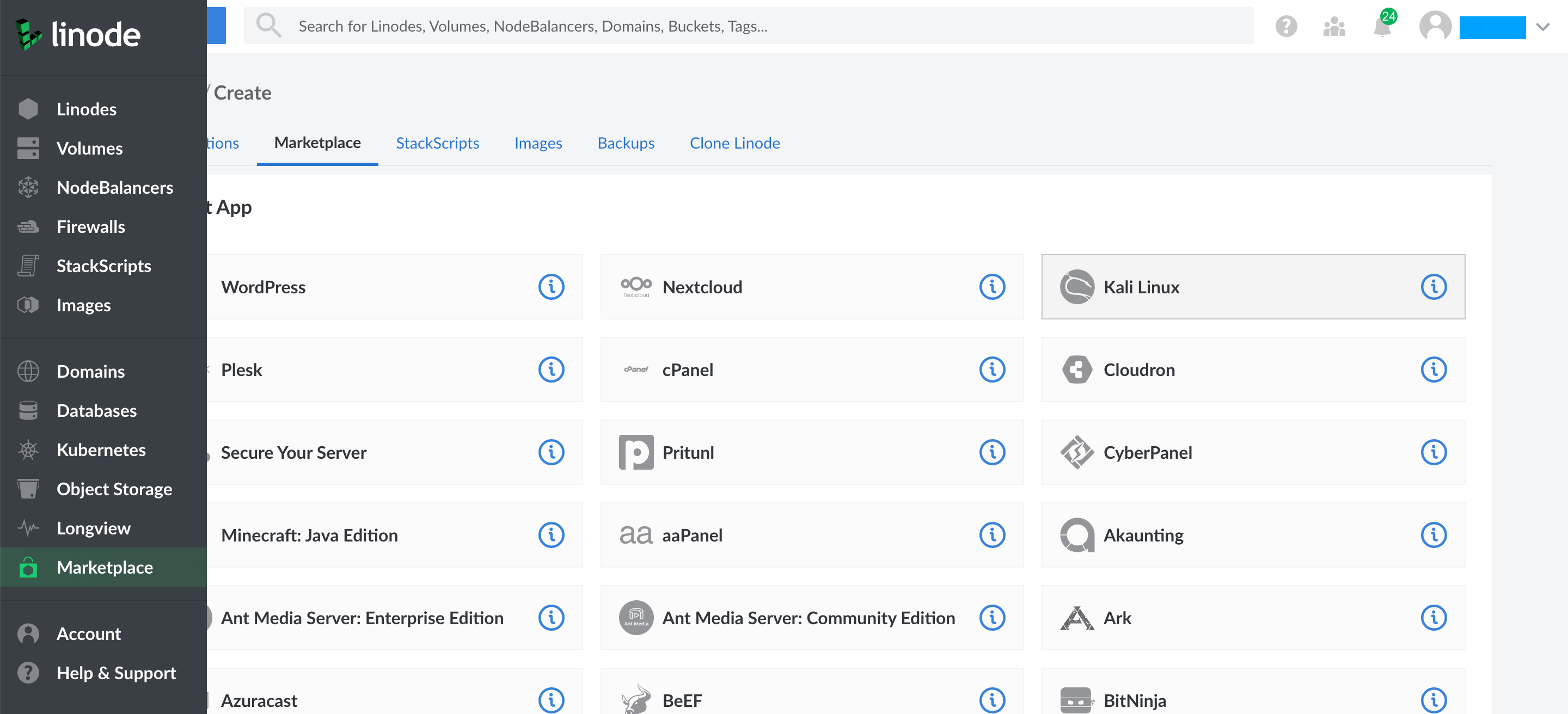
  • Alternatively, go to Linode’s marketplace, and select Kali, and scroll down…

Using Linode’s marketplace allows you to customize your Kali installation directly in the web browser! You will be asked a series of questions allowing you to personalize the installation, without having to SSH in, such as as “which metapackages to install (none, default, or everything)” or “do you want GUI access (via VNC)”? That’s pretty cool right?!
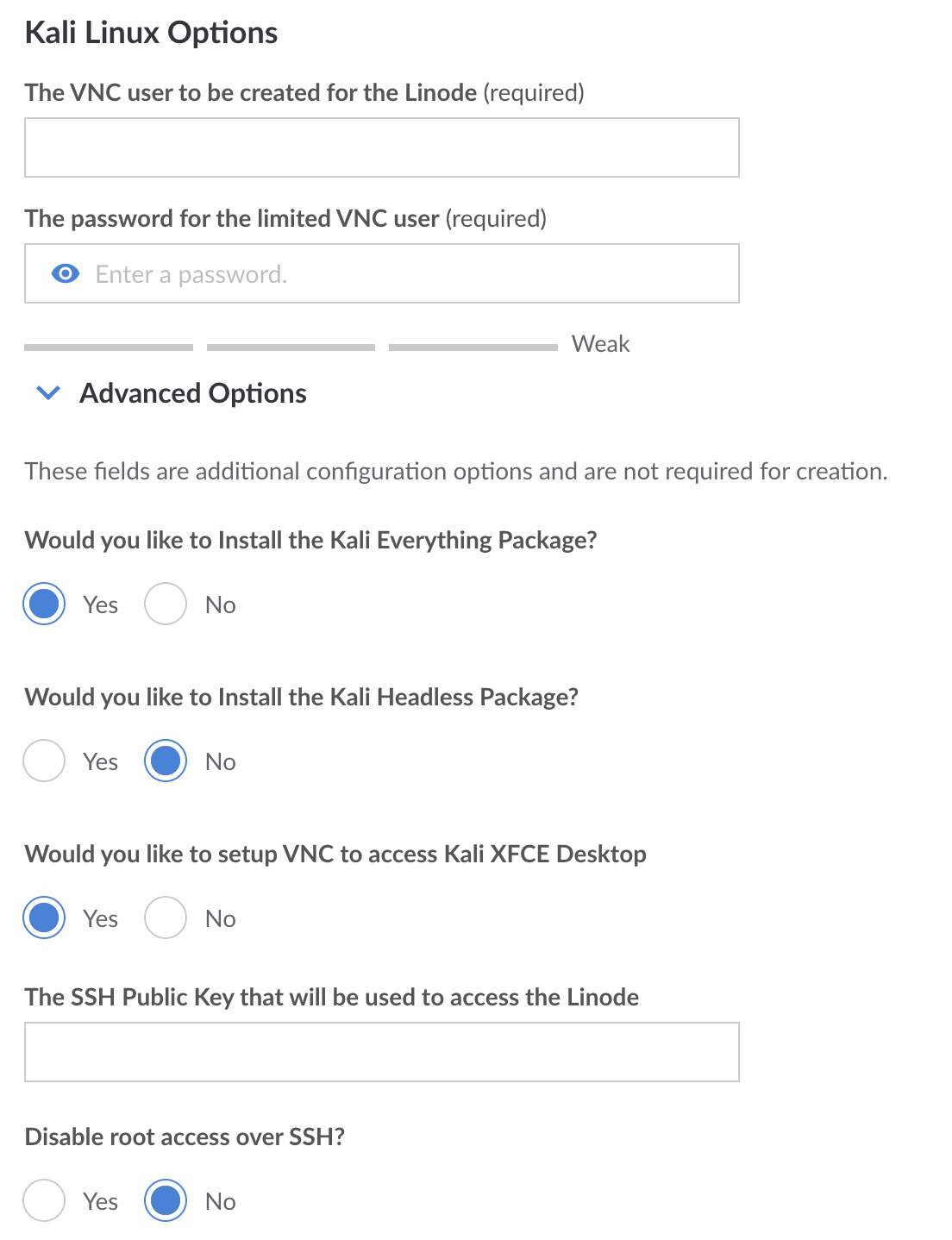

marketplace options


Which option is best? That depends on you. Some people like to have a bare install, without any tools, and as little packages as possible. You can install whichever package you want. This will reduce the running cost of the cloud instance and help you understand your system environment better.
However, if you want to get going as quickly as possible, or be in a more familiar graphical environment (using Xfce), then the market place option may be better!
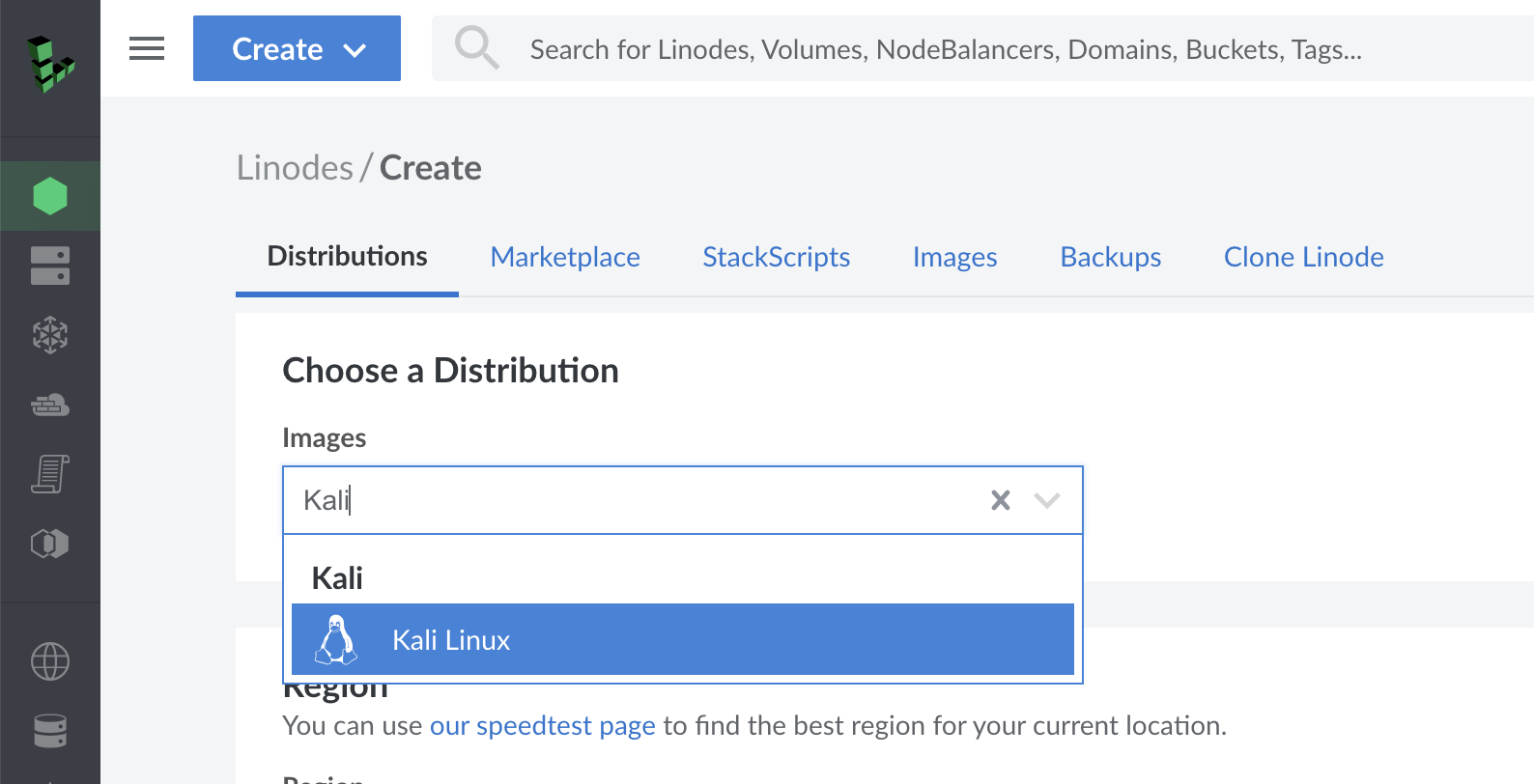
distribution


marketplace


Kali is free in Linode’s marketplace, the only cost is the running cost of a Cloud instance. How much is that? That depends on the system requirements you pick! There aren’t any extra changes for using Kali.


What’s the username/password to connect? That depends! The username will be root (by default), and the password will be what you set during setup. You can also use SSH keys if you selected one during setup also. If you installed via the marketplace, you can also use VNC details you entered.


It goes without saying, also make sure you have permission. Make sure to read the Linode’s small print, read over their security page and open up a Linode ticket if you need it in writing!


If you want more to read, check Linode’s blog post, Linode’s documentation, as well as Kali’s documentation.


Happy Hacking!

Social ReaktionenReagiere als Erste:r — dein Feedback zählt!
Informations-Bewertung:
✏️ Information ergänzen
🛡️ Versioniert via CMS-Revisions-Engine (Freigabe-Queue für Gäste)

💬 Debate de la comunidad y comentarios

🌐 Unirse al chat principal

Inicia el debate en el stream de difusión del Social Chat o envía arriba una contribución experta mediante el formulario de ampliación.

🔍 CTI & Forensik

Inteligencia de Ciberamenazas y Forense

Navegador ATT&CK · Radar IoC · Evidencias de Exploit
CTI Threat Relationship Graph
Akteure · Techniken · Beziehungen
2 Knoten · 1 Relationen
CVE / Incident Threat Actor Software MITRE ATT&CK CWE Weakness IoC
Briefing de seguridad Gratis · baja en 1 clic

Intelligence Digest — gratis

Cada día las noticias de seguridad más importantes · baja en cualquier momento

Valoración de la comunidad & prueba social
⭐ Valoración de los lectores
–
Ø / 5.0
Aún no hay valoraciones de lectores
¿Le ha resultado útil este artículo?
0
Dejar una valoración ahora
Valoración detallada (opcional)
Contenido & calidad
Fuente & credibilidad
Actualidad

Clústeres de historias relacionados & fuentes (IA vectorial)

6 Cluster
26 fuentes
CVE-2026-99690 | Linux Kernel up to 6.12.117/6.18.63/7.3.4/7.4-rc1 ocfs2 ocfs2_get_dentry_osb use after free
VulDB Updates hace 1 h
25 fuentes más
VulDB Updateshace 1 hCVE-2026-99678 | Linux Kernel up to 6.12.117/6.18.63/7.3.4/7.4-rc1 XFS xfs_iomap_write_direct integer overflow VulDB Updateshace 1 hCVE-2026-99680 | Linux Kernel up to 6.12.117/6.18.63/7.3.4/7.4-rc1 XFS xfs_fs_map_blocks allocation of resources VulDB Updateshace 1 hCVE-2026-99688 | Linux Kernel up to 6.12.117/6.18.63/7.3.4/7.4-rc1 sch_qfq net/sched/sch_qfq.c qfq_change_class use after free VulDB Updateshace 1 hCVE-2026-99679 | Linux Kernel up to 7.3.4/7.4-rc1 xfs xfs_iomap_write_unwritten allocation of resources VulDB Updateshace 1 hCVE-2026-99686 | Linux Kernel up to 6.18.63/7.3.4/7.4-rc1 vhost vhost_add_used_n_in_order integer overflow VulDB Updateshace 1 hCVE-2026-99697 | Linux Kernel up to 6.12.117/6.18.63/7.3.4/7.4-rc1 memcontrol high_work_func use after free VulDB Updateshace 1 hCVE-2026-99685 | Linux Kernel up to 6.12.117/6.18.63/7.3.4/7.4-rc1 iommu/virtio viommu_probe use after free Ubuntu security noticeshace 2 hUSN-9170-4: Linux kernel (Azure) vulnerabilities Ubuntu security noticeshace 2 hUSN-9165-2: Linux kernel vulnerabilities Ubuntu security noticeshace 2 hUSN-9168-4: Linux kernel (Azure) vulnerabilities Ubuntu security noticeshace 2 hUSN-9167-3: Linux kernel vulnerabilities Ubuntu security noticeshace 2 hUSN-9174-2: Linux kernel (Low Latency NVIDIA) vulnerabilities Ubuntu security noticeshace 2 hUSN-9173-3: Linux kernel (NVIDIA) vulnerabilities Ubuntu security noticeshace 2 hUSN-9190-1: Linux kernel vulnerabilities Ubuntu security noticeshace 2 hUSN-9191-1: Linux kernel (Azure) vulnerabilities Ubuntu security noticeshace 2 hUSN-9192-1: Linux kernel (NVIDIA) vulnerabilities VulDB Updateshace 3 hCVE-2026-99669 | Linux Kernel up to 7.3.4/7.4-rc1 Huge Memory mm/huge_memory zap_huge_pmd_folio race condition VulDB Updateshace 3 hCVE-2026-99662 | Linux Kernel up to 6.12.117/6.18.63/7.3.4/7.4-rc1 gup out-of-bounds write VulDB Updateshace 3 hCVE-2026-99672 | Linux Kernel up to 6.12.117/6.18.63/7.3.4/7.4-rc1 CAN isotp_release use after free VulDB Updateshace 3 hCVE-2026-99676 | Linux Kernel up to 6.12.117/6.18.63/7.3.4/7.4-rc1 refcount refcount_inc_not_zero_acquire locking VulDB Updateshace 3 hCVE-2026-99674 | Linux Kernel up to 7.3.4/7.4-rc1 CAN Device Driver net/can/dev.c can_dropped_invalid_skb len buffer overflow VulDB Updateshace 3 hCVE-2026-99668 | Linux Kernel up to 7.3.4/7.4-rc1 Huge Memory Management mm/huge_memory.c zap_huge_pmd_folio memory corruption VulDB Updateshace 3 hCVE-2026-99667 | Linux Kernel up to 6.18.63/7.3.4/7.4-rc1 khugepaged try_collapse_pte_mapped_thp race condition VulDB Updateshace 3 hCVE-2026-99659 | Linux Kernel up to 6.12.117/6.18.63/7.3.4/7.4-rc1 TLB Flush mm/numm_gather.c __tlb_adjust_range numeric truncation error VulDB Updateshace 3 hCVE-2026-99657 | Linux Kernel up to 6.12.117/6.18.63/7.3.4/7.4-rc1 MMU Notifier mm/mmu_notifier.c __mmu_interval_notifier_insert mm race condition
Artículos similares
🔍 Verwandte News

Auch interessante Nachrichten Kali Linux in Linode's Cloud

Thematisch verwandte Begriffe: Kali, Linux, Linodes, Cloud · 6 Treffer

Laden...

Cargando vídeos ...

Laden...

Cargando artículos ...

Laden...

Cargando vídeos ...

Laden...

Cargando artículos ...

Laden...

Cargando vídeos ...

Laden...

Cargando artículos ...

Laden...

Cargando vídeos ...

Laden...

Cargando artículos ...

Laden...

Cargando vídeos ...

💬 Cargando comentarios…
Desliza para actualizar
Widgets & Topics
Loading widgets…
Nächster Beitrag