
Zum Hauptinhalt springen
LIVE
CVSS 6.9CVE-2026-137684 | A security flaw has been discovered in eosphoros-ai DB-GPT up to 0.8.3. This affects the function editor_sql_run of the file packages/dbgpt-app/src/dbgpt_app/openapi/api_v1/editor/api_editor_v1.py of the component Editor SQL Run API. Performing a manipulation of the argument db_name results in authorization bypass. It is possible to initiate the attack remotely. The exploit has been released to the public and may be used for attacks. The pull request to fixCVSS 8.7CVE-2026-137992 | libexpat through 2.11.0 contains a denial of service vulnerability in defineAttribute() of lib/xmlparse.c that fails to detect duplicate non-ID #IMPLIED or #REQUIRED attribute declarations. Attackers can supply a crafted XML document with repeated ATTLIST declarations in an internal DTD subset to cause quadratic CPU consumption in storeAtts() during parsing.CVSS 8.5CVE-2026-137994 | Leo through 6.8.10 contains an insecure deserialization vulnerability that allows attackers to execute code by embedding pickled data in unknown XML attributes of .leo outlines. Attackers can place a pickle __reduce__ gadget in a or element attribute that resolveUa passes to pickle.loads, executing code with user privileges when the outline is opened.CVSS 7.0CVE-2026-137995 | FOG Project before 1.6.0.119 contains an information disclosure vulnerability that allows unauthenticated attackers to obtain host tokens from status/hostgetkey.php by supplying a host MAC address. Attackers can present the token to service/hostinfo.php to retrieve decrypted Active Directory join credentials and Windows product keys during deployment windows.CVSS 6.8CVE-2026-137996 | Zettlr before 4.11.0 fails to validate URI schemes in Markdown link targets, allowing attackers to launch arbitrary registered protocol handlers via Electron shell.openExternal without confirmation. Attackers can craft documents whose Ctrl/Cmd-clicked links use smb:// to leak NTLM credential hashes on Windows or invoke custom protocol handlers with attacker-controlled parameters.CVSS 8.5CVE-2026-137997 | HCIPy through 0.7.1 contains an insecure deserialization vulnerability that allows attackers to execute code by supplying crafted .pkl files to read_field, read_grid or read_mode_basis. Because hcipy/util/io.py selects pickle by file extension and calls pickle.load, a __reduce__ gadget in a pupil, apodizer, PSF or mode-basis file runs code with the user's privileges.CVSS 8.5CVE-2026-137998 | Detoxify 0.5.3 through 0.5.4 contains an insecure deserialization vulnerability in load_checkpoint that allows attackers to execute code by supplying a crafted checkpoint file. Attackers can embed a pickle __reduce__ gadget in a .ckpt file loaded via torch.load with weights_only=False to run code with the user's privileges.CVSS 8.5CVE-2026-137999 | JSONSchema2PoPo2 through 3.0.3 contains a code injection vulnerability that allows attackers to inject Python code by supplying JSON Schema default or format values that are written unescaped. Attackers can place a single quote in a string property default to break out of the literal in the generated __init__ signature, executing injected code when the generated module is imported.
Alle im Drawer
Intelligence View
⚡ tsecurity.de Intelligence

Kali Linux in Linode's Cloud

A few months ago, Linode reached out to us asking “What would be needed in order to get Kali added to Linode?”. We explained to them how all the build-scripts t…

Beitrag
0
Seite
0
↗ Quelle (kali.org)
Cloud & Tech-Stack · 3 Min. Lesezeit
Quelle: kali.org
Rubrik: Admin & Dev Tools

A few months ago, Linode reached out to us asking “What would be needed in order to get Kali added to Linode?”. We explained to them how all the build-scripts that we used to create Kali are public, and what their different options and configurations mean. They went away and came back shortly with an image for us to try out! After a bit of testing, we can now say “Kali is in Linode… (Twice)”!


Twice? You can get Kali two ways. Either:


  • Create a new Linode and select Kali as the Distribution. This gives you a bare install of Kali without any tools.

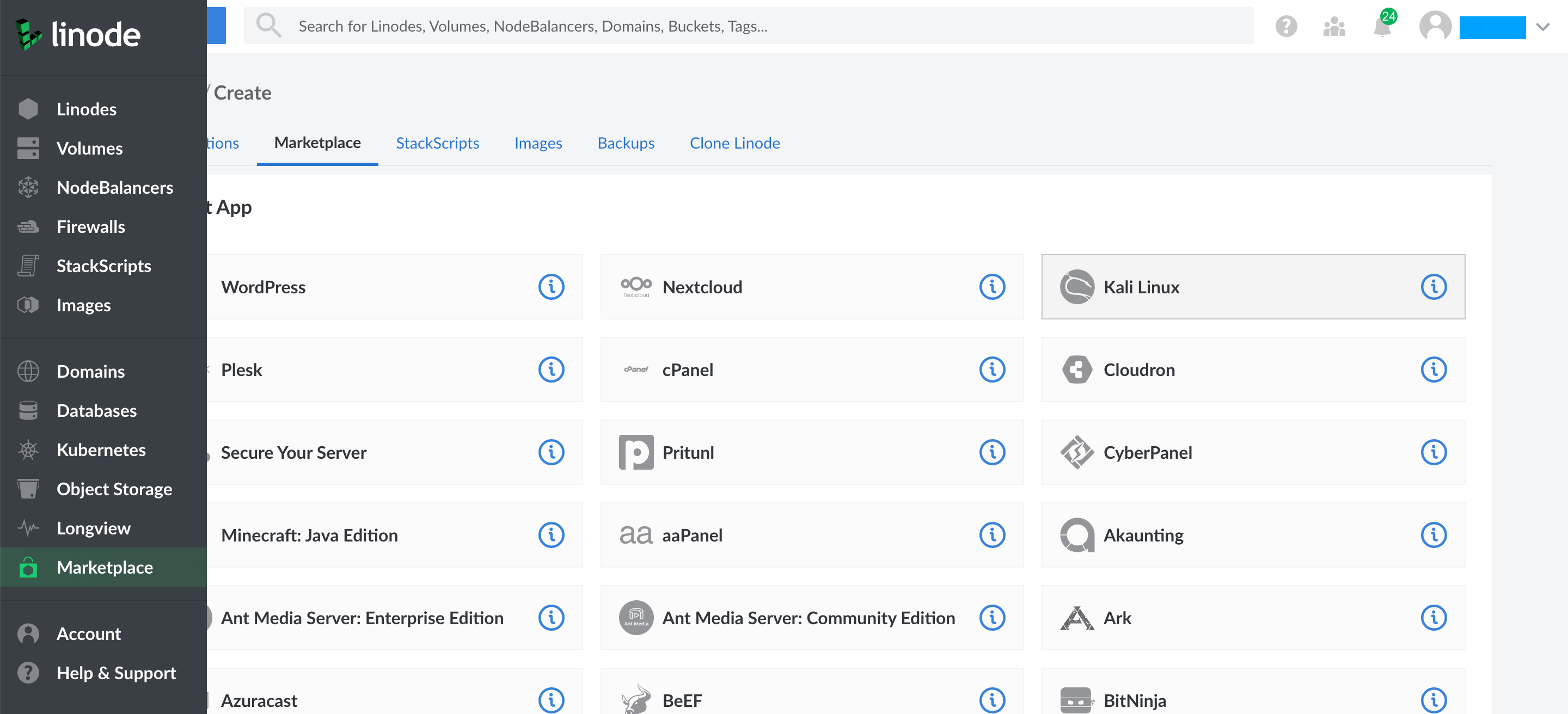
  • Alternatively, go to Linode’s marketplace, and select Kali, and scroll down…

Using Linode’s marketplace allows you to customize your Kali installation directly in the web browser! You will be asked a series of questions allowing you to personalize the installation, without having to SSH in, such as as “which metapackages to install (none, default, or everything)” or “do you want GUI access (via VNC)”? That’s pretty cool right?!
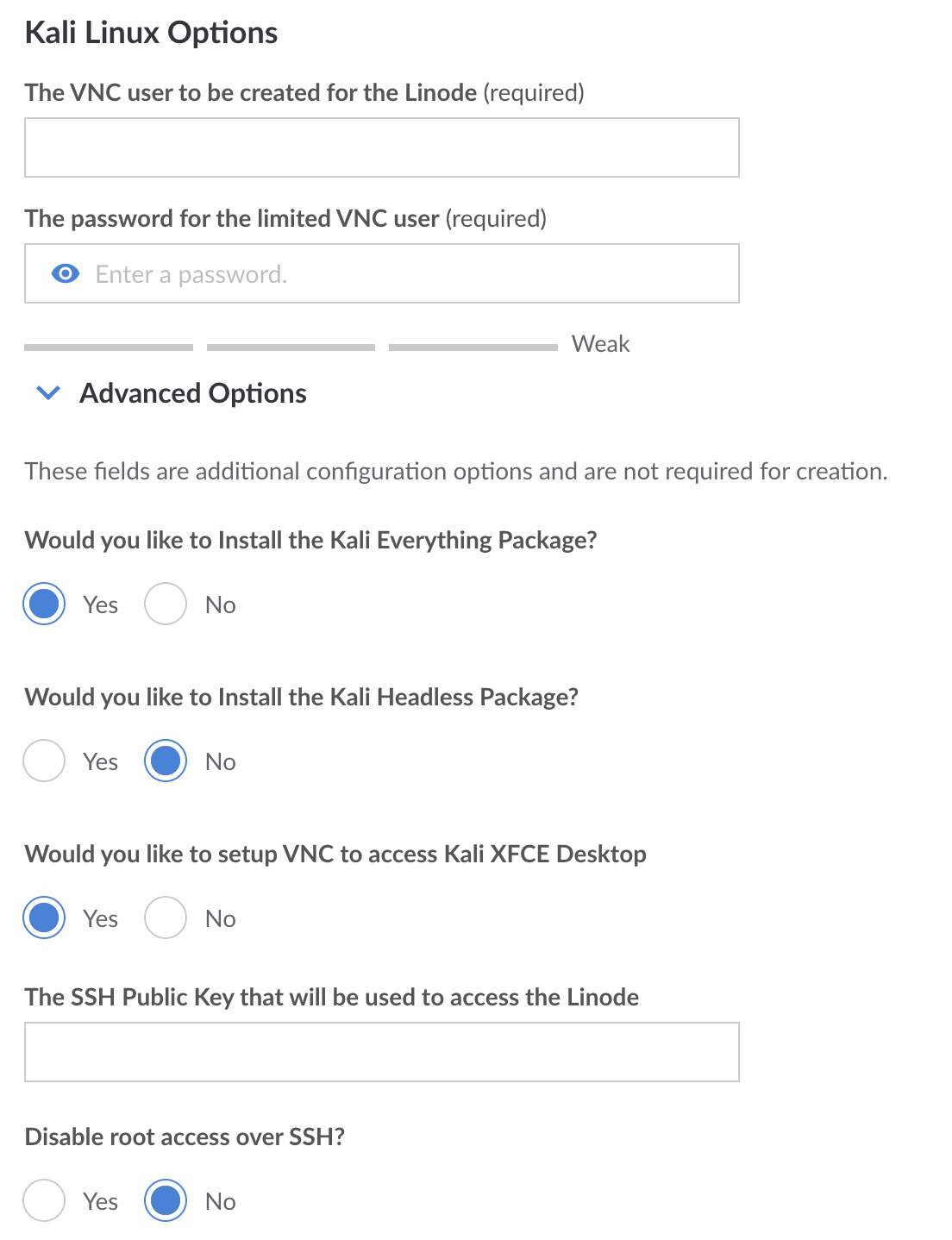

marketplace options


Which option is best? That depends on you. Some people like to have a bare install, without any tools, and as little packages as possible. You can install whichever package you want. This will reduce the running cost of the cloud instance and help you understand your system environment better.
However, if you want to get going as quickly as possible, or be in a more familiar graphical environment (using Xfce), then the market place option may be better!
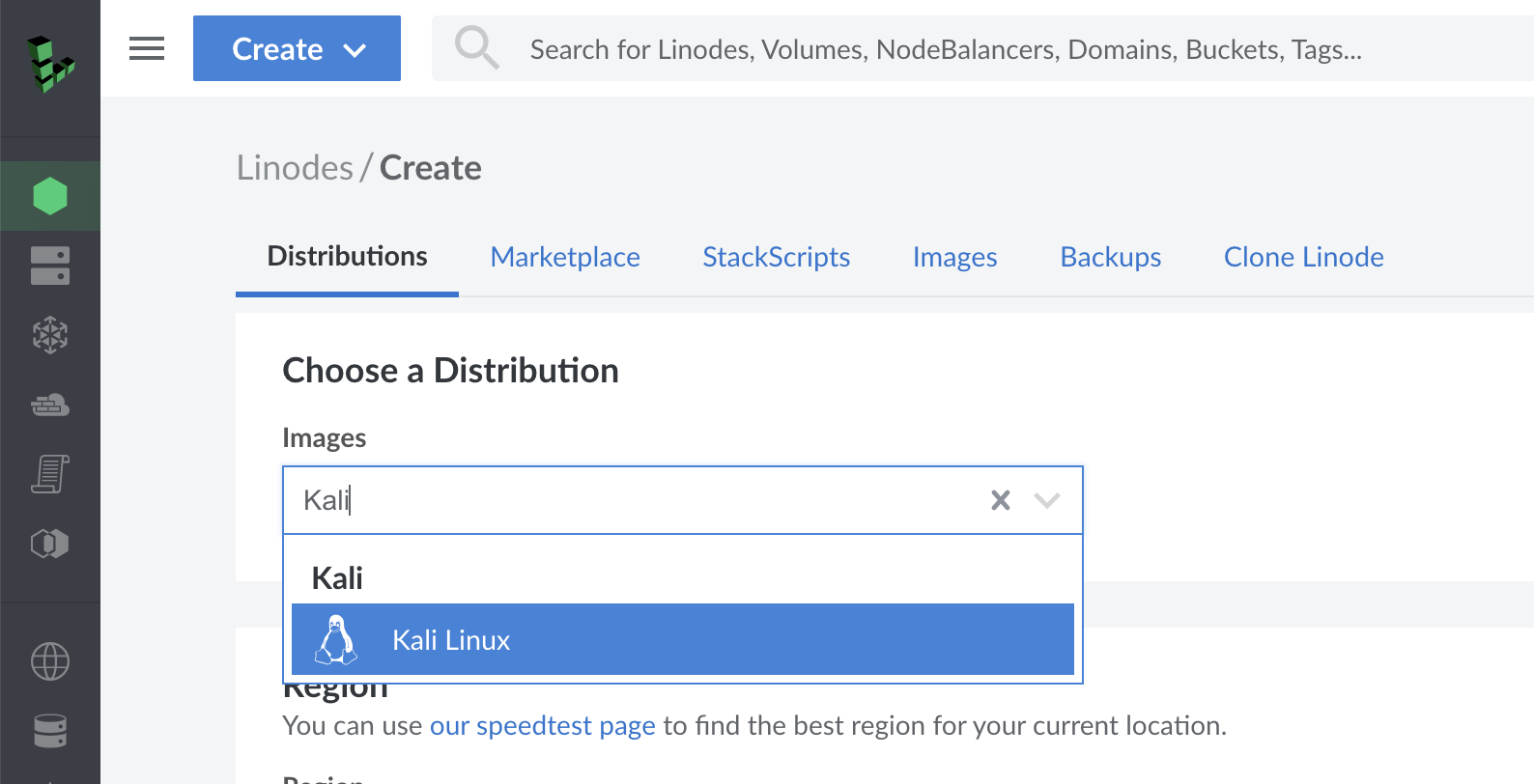
distribution


marketplace


Kali is free in Linode’s marketplace, the only cost is the running cost of a Cloud instance. How much is that? That depends on the system requirements you pick! There aren’t any extra changes for using Kali.


What’s the username/password to connect? That depends! The username will be root (by default), and the password will be what you set during setup. You can also use SSH keys if you selected one during setup also. If you installed via the marketplace, you can also use VNC details you entered.


It goes without saying, also make sure you have permission. Make sure to read the Linode’s small print, read over their security page and open up a Linode ticket if you need it in writing!


If you want more to read, check Linode’s blog post, Linode’s documentation, as well as Kali’s documentation.


Happy Hacking!

Information ergänzen Fachhinweis, Update, Korrektur oder Quelle zur Meldung beitragen
Gäste-Hinweise werden kurz redaktionell geprüft und danach hier angezeigt.

Community-Hinweise zur Meldung

0 freigegeben
Social ReaktionenReagiere als Erste:r — dein Feedback zählt!
Informations-Bewertung:

💬 Topluluk tartışması ve yorumlar

🌐 Ana sohbete katıl

Tartışmayı başlat: Social Chat yayın akışı veya yukarıdaki ekleme formuyla uzman katkısı gönder.

Siber Tehdit İstihbaratı ve Adli Bilişim

ATT&CK Gezgini · IoC Radarı ve Graf

CTI Threat Relationship Graph
Akteure · Techniken · Beziehungen
2 Knoten · 1 Relationen
CVE / Incident Threat Actor Software MITRE ATT&CK CWE Weakness IoC
Community Rating & Social Proof
⭐ Okuyucu Puanı
–
Ø / 5.0
Hiçbir okuyucu henüz yorum yok
Bu makale yararlı mıydı?
0
Değerlendirmenizi gönderin
Detaylı değerlendirme (isteğe bağlı)
İçerik ve Kalite
Kaynak ve Güvenilirlik
Güncellik
Security Briefing Ücretsiz · Tek tıkla abonelikten çıkma

Zeka Digest - ücretsiz

Günlük en önemli güvenlik haberi · herhangi bir zamanda alınabilir

İlgili Story Cluster & Kaynaklar (vector AI)

2 Cluster
2 Kaynaklar
CVE-2026-93653 | Red Hat Enterprise Linux/Hardened Images Splash Backend tilingPatternFill denial of service (EUVD-2026-82931)
VulDB Updates 2 saat önce
1 başka bir kaynak
Benzer katkılar
🔍 Verwandte News

Auch interessante Nachrichten Kali Linux in Linode's Cloud

Thematisch verwandte Begriffe: Kali, Linux, Linodes, Cloud · 6 Treffer

Laden...

Videolar yükleniyor...

Laden...

Contributions yüklenir ...

Laden...

Videolar yükleniyor...

Laden...

Contributions yüklenir ...

Laden...

Videolar yükleniyor...

Laden...

Contributions yüklenir ...

Laden...

Videolar yükleniyor...

Laden...

Contributions yüklenir ...

Laden...

Videolar yükleniyor...

Yorumlar yüklenir..
Update to Update
Widgets & Topics
Loading widgets…
Nächster Beitrag